
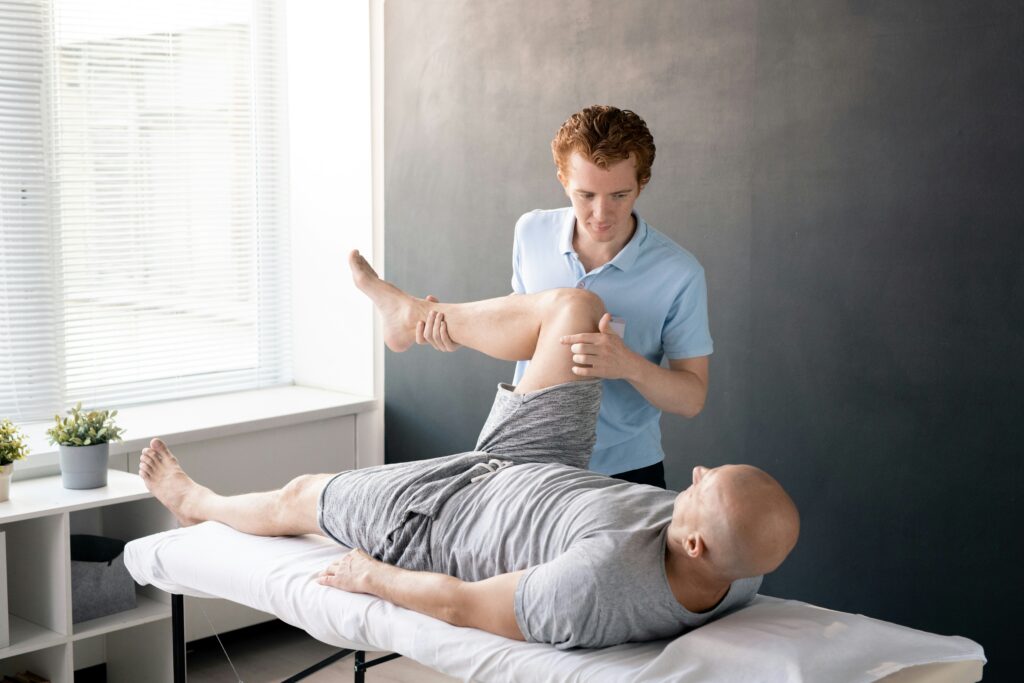
How to Safely Transition from Injury Rehabilitation Back to High-Impact Sports
Obtaining approval to go back to sports after an injury does not mean that you are actually prepared to do so. This is when most re-injuries occur. People need a more careful approach in order to close the gap between being discharged and actually being ready to perform at your best.
Why calendar timelines fail athletes
The reassuring news is that athletic trainers have been great at documenting what these performance benchmarks need to be for many different sports. Take the NBA, for example. Thanks to the tireless research of institutions like the Mayo Clinic, we have a pretty good idea of what maximal safe athletic output should look like on both the left and right leg for a 6’5" shooting guard following an ACL reconstruction. We know how strong the quads need to be. We know how high and how far they should jump on a hop test. We know how fast they need to be on a straight-line sprint. If we have the right equipment, we can even measure on-court exertion in a practice or game on how hard it is to expend effort. We now have similar data on NFL, NHL, MLB, and professional soccer players, as well as athletes in many non-professional sports.
So our question is: why would anyone return a player to competition if they haven’t met these benchmarks given what’s at stake? Have we forgotten what the first injury cost teams and their players? The level of LSI testing required to optimize and protect an athlete’s second knee appearance is trivial to administer. It can be done in less than an hour in most cases and it’s easy to set up at most facilities for almost no cost. It’s not unusual for its validity to be reinforced with video we take on a smartphone. So, it’s hard to imagine what the barrier is to letting an athlete get back to 100%, but waiting for the objective tests to indicate they are.
The fear factor nobody talks about
The most glib way to phrase it is simply that, biologically, feeling better doesn’t mean being better. A slightly more eloquent terminology you’ve probably heard is "pain is an opinion." Pain is a biological mechanism that is triaged by the nervous system and the brain. The body is constantly receiving information from its environment, including internal environment, and interpreting it in terms of safety – real or perceived threat.
Pain is not a direct input. There’s no single "pain receptor." Pain is an output, a response to all of the input the body is receiving. Danger, likewise, is an output. When you experience pain, the body reflexively attempts to protect itself. Attention is drawn irresistibly to the source of the pain. We wince, cry out, recoil. Nerves can become more sensitive – the more of that input they receive, the better they become at receiving it.
Managing load during the transition
One of the most practically useful frameworks for bridging rehabilitation into full training is the acute-to-chronic workload ratio (ACWR), developed largely through the work of sports scientist Tim Gabbett. The concept is straightforward: your chronic workload is the four-week rolling average of training load, and your acute workload is the most recent week. When the ratio of acute to chronic exceeds 1.3 – meaning you’ve spiked your training load too hard too fast – soft tissue injury risk rises sharply. Drop below 0.8 and the athlete is undertrained relative to their baseline, which carries its own risks.
During rehabilitation, chronic workload is almost always low. This is the core danger of the transition phase. An athlete who returns to full team training after six weeks of limited rehab work has a near-zero chronic load and is functionally a deconditioned athlete regardless of what their MRI shows. Reintroducing sport-specific loading should happen gradually, keeping the ACWR between 0.8 and 1.3 throughout, tracking actual training volumes week by week rather than relying on feel.
How ankle injuries become back problems
The kinematic chain is WHY movement at one joint impacts movement at the joints above and below it. Treating injuries in silos is covering a part of the problem, but not the full picture. An ankle that gets put in a boot and left alone for two months lost dorsiflexion range. In a squat or landing scenario, the knee drives inward, the hip drops, and the lumbar spine flexes. All the stress shifts away from the rehabbed ankle and onto those other structures.
The ankle seems to be all healed up – good news. Except now, the hip labrum is chewing up and the athlete is loading their lumbar discs in ways they haven’t had to before. Thousands of reps later, lo and behold, the secondary injury engines are humming.
Addressing global movement patterns – not just the injury site – is non-negotiable. This is where working with Florida physical therapists who specialize in return-to-sport progressions makes a concrete difference. Specialized practitioners run movement screens and force plate assessments to catch these compensations before they become secondary injuries, applying objective criteria rather than a "looks good, go ahead" sign-off based on how long ago the surgery was.
Breaking down the forces your sport actually demands
High-impact sport doesn’t stress your body in the same way. You can break the loading demands down into 3 very different vectors: axial loading (basically all the joints being compressed from jumping, landing, and contact), rotational torque (the knee and hip being twisted during cutting and pivoting), and rapid deceleration (the eccentric demand of trying to halt your momentum). You need to isolate all three in the gym before you start to combine them on the field.
The eccentric strength is most often underestimated by athletes. This is the ability of a muscle to lengthen under tension. Absorbing that contact, rather than just pushing or jumping, is what saves your joints. The rate of force development (RFD) is the other half of the equation that usually goes out the window. You will eventually reach your maximal force production in the 400-600 ms you might have to develop it in a dynamic sport. How fast you can get to those high threshold motor units, however, is what really matters. Both can be tested and improved.
The plyometric progression
You should introduce Plyometrics step by step, not all at once. The progression is as follows:
Begin with bilateral landing mechanics at low amplitude – that is, box steps, controlled two-foot landings, nothing reactive. The aim here is to learn again how to symmetrically absorb force, with speed or unpredictability.
From there, transition to low-amplitude unilateral hops. Single-leg work begins rebuilding the proprioceptive feedback loops that joint injuries destroy, and also exposes the asymmetry that bilateral drills mask.
The proprioceptive system – which is the body’s ability to sense joint position and movement in space – is consistently damaged in ligament and cartilage injuries and must be specifically retrained rather than assumed to recover.
The final stage will be high-velocity, reactive depth jumps and direction changes. At this point, the athlete needs to be operating in what sports scientists call open-loop conditions: unpredictable environments that demand real-time visual-motor reaction rather than pre-planned movement. A good final measure of readiness is whether the athlete can react to unpredictable stimuli from opponents in real time, not just execute pre-planned drills.
The rehab cliff
Physical therapy covered by insurance usually finishes long before an athlete is ready to return to the game. The clinical rehabilitation phase may include sufficient steps so the person can walk normally, manage staircases, and function in daily life – which are all very important indicators. However, they are not proper return-to-sport indicators. The difference between "functional" and "game-speed ready" is considerable, and it is not captured by standard clinical discharge indicators.
This point of loss is sometimes referred to as the rehabilitation cliff. The patient is released, the institutional support ends, and the patient is expected to somehow bridge the last gap by themselves – usually by just joining back in group training, not having enough of a loading history, and having no one monitor the quality of their movement or their recovery. It’s the window in athletic rehabilitation with the greatest number of predictable injuries.
The alternative is a planned hand-over to a sports physio or performance coach who can drive progressive loading, monitor ACWR week-to-week, and manage the objective criteria testing that actually determines sport readiness. This is not optional care for elite athletes. It is the portion of the process that decides if the initial rehabilitation was a waste of time or not.
Closed kinetic chain before open kinetic chain
Regarding exercise selection, closed kinetic chain exercises such as squats, step-ups, and leg presses are recommended for early-stage strength work because they spread the load over multiple joints and resemble functional movements. For later stages and to target specific muscle groups or address any particular strength deficit, open kinetic chain exercises like seated leg extensions become important.
It is essential to tie everything together with periodization, as planning the training volume and intensity helps to gradually increase the load and then provide recovery time. A structured plan facilitates the progression of an athlete from rehabilitation to practice and finally to game-level without any sudden load increases that could lead to soft tissue injuries. Hence, a return-to-sport plan is based on well-established principles, just like designing a training program for healthy athletes, starting from a lower fitness level.
Returning to a high-impact sport after an injury is one of the most challenging phases in an athlete’s recovery journey. Successful athletes are not the ones who rely on their "feel" of readiness but instead the ones who meet or exceed certain criteria and training benchmarks. Competitive sports demand reactive movements, and these need to be included in the training program. The athletes who choose to skip this phase often pay the price.